

Racing
The Evolution of F1 Technology: How Innovations Shape the Future of Racing
Mar
1. Introduction
Formula 1 (F1) is more than just a high-speed motorsport—it’s a laboratory for cutting-edge automotive technology. Since its inception in 1950, F1 has been at the forefront of engineering advancements, shaping the future of road cars and motorsports alike. Every decade has witnessed revolutionary breakthroughs, from aerodynamics to hybrid power units.
This article explores how F1 technology has evolved over the decades, the key innovations that have changed the sport, and how these advancements will shape the future of racing.
2. The Early Years of F1 Technology (1950s-1970s)
Birth of Formula 1 and Early Engineering (1950s-1960s)
When F1 began in 1950, car designs were simple, resembling modified road cars rather than sophisticated race machines. The first F1 cars featured front-mounted engines, minimal aerodynamics, and heavy steel chassis. However, teams quickly realized that speed and efficiency required a shift in engineering philosophy.
One of the most significant early innovations was the mid-engine layout, introduced by Cooper in 1957. Instead of placing the engine at the front, this new design positioned it behind the driver, improving weight distribution and handling. By the early 1960s, all competitive F1 teams had adopted mid-engine designs, setting a precedent for modern racing.

Caption: Classic F1 cars from the 1950s featured front-engine designs, limiting aerodynamics and speed.
The Rise of Aerodynamics (1960s-1970s)
Aerodynamics became a crucial factor in the late 1960s when teams experimented with adding wings to generate downforce. The Lotus 49, introduced in 1967, was one of the first cars to use wings effectively, allowing higher cornering speeds by pushing the car down onto the track.
The ground effect concept, pioneered by Lotus in 1977, marked another leap forward. By designing car floors to channel air efficiently, teams created a vacuum effect that significantly increased downforce without adding drag. However, safety concerns led to regulations limiting ground-effect designs in the 1980s.

Caption: The Lotus 49 was a game-changer in the 1960s, introducing effective aerodynamics in F1.
Safety Innovations: The First Steps Toward Protecting Drivers
Early F1 races were notorious for their danger, with minimal safety precautions. However, the increasing speeds and fatal crashes led to major safety improvements. In the late 1960s and early 1970s, mandatory roll bars, seat belts, and fire-resistant suits became standard.
One of the most significant safety milestones came in 1968, when Helmets and fire-resistant suits were made mandatory. As speeds increased, FIA regulations continued to evolve, laying the foundation for modern driver protection.
3. The Turbo Era and Electronic Advancements (1980s-1990s)
The Power of Turbocharged Engines (1980s)
The 1980s saw the introduction of turbocharged engines, drastically increasing horsepower and revolutionizing F1 performance. Turbo engines, first introduced by Renault in 1977, reached their peak in the mid-1980s, with some engines producing over 1,400 horsepower in qualifying mode.
However, turbo engines also had drawbacks, including high fuel consumption and reliability issues. In 1989, FIA banned turbo engines, pushing teams toward naturally aspirated engines for better efficiency and reliability.
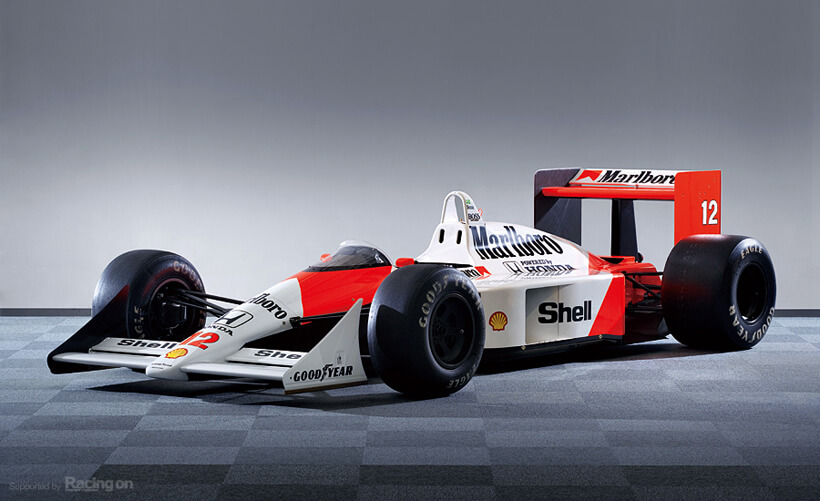
Caption: The McLaren MP4/4, powered by a Honda turbo engine, dominated the 1988 season with 15 wins out of 16 races.
Carbon Fiber Revolution and Advanced Chassis Design
The 1980s also introduced carbon fiber monocoque chassis, a breakthrough pioneered by McLaren in 1981 (MP4/1). Unlike traditional aluminum structures, carbon fiber was lighter, stronger, and offered superior crash protection.
By the 1990s, carbon fiber had become the industry standard, reducing car weight while improving structural integrity. This innovation not only enhanced performance but also played a critical role in improving driver safety.
Electronic Systems and the Rise of Driver Aids (1990s)
The 1990s marked the beginning of electronic driver aids, transforming how drivers controlled their cars. Innovations included:
- Semi-automatic gearboxes (Ferrari 1989) – Allowed drivers to shift gears without a clutch, improving efficiency.
- Traction Control (1993) – Helped drivers maintain grip, especially in wet conditions.
- Active Suspension (1992-1993 Williams FW14B) – Automatically adjusted the car’s height for optimal aerodynamics and stability.
Despite their advantages, many of these driver aids were banned in 1994 to bring back the human element in racing and reduce excessive reliance on technology.
4. The Rise of Hybrid Power Units and Modern Aerodynamics (2000s-2020s)
Introduction of Hybrid Technology (2000s-Present)
As environmental concerns and fuel efficiency became a priority, hybrid power units revolutionized Formula 1. In 2009, F1 introduced the Kinetic Energy Recovery System (KERS), allowing cars to store energy from braking and reuse it for additional power.
By 2014, F1 had completely transitioned to hybrid turbocharged V6 engines, incorporating:
- Energy Recovery System (ERS) – Captures and reuses energy from braking and exhaust heat.
- MGU-K & MGU-H – Electric motor generators enhancing power and efficiency.
- Turbo Hybrid Units – Combining turbocharging with battery-assisted performance, reducing fuel consumption while maintaining speed.
These advancements drastically improved efficiency by 35%, making modern F1 cars the most fuel-efficient in history while maintaining speeds close to their V10 and V8 predecessors.

Caption: The introduction of hybrid power units in 2014 transformed F1 into a more efficient and sustainable motorsport.
Aerodynamic Innovations: DRS, Complex Wings, and Computational Modeling
Modern F1 cars rely heavily on aerodynamics to maximize speed and efficiency. Since the early 2000s, teams have used wind tunnels and Computational Fluid Dynamics (CFD) to optimize airflow.
Key aerodynamic innovations include:
- Drag Reduction System (DRS) (2011-Present) – A movable rear wing that reduces drag for easier overtaking.
- High-Downforce Front Wings – Designed with multiple elements to direct airflow efficiently.
- Ground Effect (2022 Regulation Change) – A return to controlled ground-effect aerodynamics to improve racing quality.
The 2022 rule changes significantly reduced dirty air, making it easier for cars to follow each other and increasing overtaking opportunities.
Caption: The Drag Reduction System (DRS) helps cars reduce aerodynamic drag, increasing speed on straights for overtaking.
Tire Evolution and Its Impact on Strategy
Tires have always played a crucial role in F1 performance. Over the years, manufacturers like Goodyear, Bridgestone, Michelin, and Pirelli have developed tires that balance grip, durability, and strategy.
Since 2011, Pirelli has been F1’s exclusive tire supplier, designing tires with different compounds to add strategic variety. Teams must now carefully manage:
- Soft, medium, and hard tire choices – Affecting grip levels and longevity.
- Weather-dependent compounds – Wet and intermediate tires for rainy conditions.
- Tire degradation – Influencing pit stop strategy and race tactics.
Caption: Pirelli provides multiple tire compounds, each with different grip and wear characteristics, adding complexity to race strategy.
5. Sustainability and the Future of F1 Technology
FIA’s Push for Carbon Neutrality by 2030
In recent years, Formula 1 has committed to sustainability, with FIA aiming for carbon neutrality by 2030. This initiative includes:
- Sustainable fuel development (2026) – New biofuels with 100% carbon-neutral properties.
- Improved hybrid engines – Further efficiency improvements while maintaining high performance.
- Reduction in energy consumption – Use of renewable energy sources in F1 operations.
These efforts align with the global push for eco-friendly motorsports and automotive industries.
Electric and Hydrogen-Powered F1: A Future Possibility?
As Formula E continues to grow, many have speculated whether F1 will go fully electric. However, FIA has rejected the idea for now, focusing instead on sustainable hybrid solutions.
An alternative being explored is hydrogen-powered racing, which could offer high performance with zero emissions. While still in early research stages, hydrogen fuel cell technology could shape the future of motorsports.
%20-%20MOD)
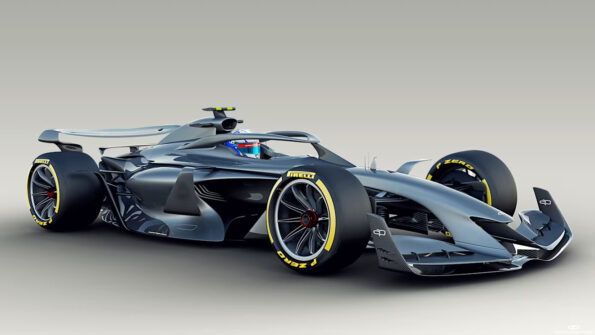
Caption: Future F1 cars may adopt hydrogen fuel cells or even fully electric powertrains as sustainability becomes a priority.
The Role of AI and Machine Learning in Racing
Artificial intelligence (AI) and data analytics are becoming increasingly important in race strategy and car development. Teams use AI to:
- Optimize fuel consumption and tire wear.
- Predict weather and track conditions.
- Improve real-time race strategy based on competitor data.
In the near future, AI may even play a role in autonomous testing, helping teams refine car setups before race weekends.
6. Conclusion
Formula 1 has always been a battleground for technological advancement. From mid-engine layouts and turbocharged power units to hybrid systems and aerodynamic mastery, F1 innovations have shaped not only motorsport but also the wider automotive industry.
As the sport moves toward a more sustainable and technologically advanced future, F1 will continue to balance speed, safety, and environmental responsibility. With FIA’s commitment to carbon neutrality and next-generation engine development, the future of F1 is set to be more thrilling than ever.
Whether through new materials, AI-driven strategies, or alternative fuels, Formula 1 remains a testbed for cutting-edge technology, influencing the future of motorsports and the automotive world.
